 Add to Chrome
 Add to Firefox
 Add to Edge
Score-Based Causal Discovery of Latent Variable Causal Models
May 19, 2026
Identifying latent variables and the causal structure involving them is essential across various scientific fields. While many existing works fall under the category of constraint-based methods (with e.g. conditional independence or rank deficiency tests), they may face empirical challenges such as testing-order dependency, error propagation, and choosing an appropriate significance level. These issues can potentially be mitigated by properly designed score-based methods, such as Greedy Equivalence Search (GES) (Chickering, 2002) in the specific setting without latent variables. Yet, formulating score-based methods with latent variables is highly challenging. In this work, we develop score-based methods that are capable of identifying causal structures containing causally-related latent variables with identifiability guarantees. Specifically, we show that a properly formulated scoring function can achieve score equivalence and consistency for structure learning of latent variable causal models. We further provide a characterization of the degrees of freedom for the marginal over the observed variables under multiple structural assumptions considered in the literature, and accordingly develop both exact and continuous score-based methods. This offers a unified view of several existing constraint-based methods with different structural assumptions. Experimental results validate the effectiveness of the proposed methods.

Causal Representation Learning from General Environments under Nonparametric Mixing
Apr 26, 2026Causal representation learning aims to recover the latent causal variables and their causal relations, typically represented by directed acyclic graphs (DAGs), from low-level observations such as image pixels. A prevailing line of research exploits multiple environments, which assume how data distributions change, including single-node interventions, coupled interventions, or hard interventions, or parametric constraints on the mixing function or the latent causal model, such as linearity. Despite the novelty and elegance of the results, they are often violated in real problems. Accordingly, we formalize a set of desiderata for causal representation learning that applies to a broader class of environments, referred to as general environments. Interestingly, we show that one can fully recover the latent DAG and identify the latent variables up to minor indeterminacies under a nonparametric mixing function and nonlinear latent causal models, such as additive (Gaussian) noise models or heteroscedastic noise models, by properly leveraging sufficient change conditions on the causal mechanisms up to third-order derivatives. These represent, to our knowledge, the first results to fully recover the latent DAG from general environments under nonparametric mixing. Notably, our results match or improve upon many existing works, but require less restrictive assumptions about changing environments.
A General Representation-Based Approach to Multi-Source Domain Adaptation
Apr 26, 2026A central problem in unsupervised domain adaptation is determining what to transfer from labeled source domains to an unlabeled target domain. To handle high-dimensional observations (e.g., images), a line of approaches use deep learning to learn latent representations of the observations, which facilitate knowledge transfer in the latent space. However, existing approaches often rely on restrictive assumptions to establish identifiability of the joint distribution in the target domain, such as independent latent variables or invariant label distributions, limiting their real-world applicability. In this work, we propose a general domain adaptation framework that learns compact latent representations to capture distribution shifts relative to the prediction task and address the fundamental question of what representations should be learned and transferred. Notably, we first demonstrate that learning representations based on all the predictive information, i.e., the label's Markov blanket in terms of the learned representations, is often underspecified in general settings. Instead, we show that, interestingly, general domain adaptation can be achieved by partitioning the representations of Markov blanket into those of the label's parents, children, and spouses. Moreover, its identifiability guarantee can be established. Building on these theoretical insights, we develop a practical, nonparametric approach for domain adaptation in a general setting, which can handle different types of distribution shifts.
SEDGE: Structural Extrapolated Data Generation
Apr 02, 2026This paper proposes a framework for Structural Extrapolated Data GEneration (SEDGE) based on suitable assumptions on the underlying data generating process. We provide conditions under which data satisfying new specifications can be generated reliably, together with the approximate identifiability of the distribution of such data under certain ``conservative" assumptions. On the algorithmic side, we develop practical methods to achieve extrapolated data generation, based on the structure-informed optimization strategy or diffusion posterior sampling, respectively. We verify the extrapolation performance on synthetic data and also consider extrapolated image generation as a real-world scenario to illustrate the validity of the proposed framework.
Latent Variable Causal Discovery under Selection Bias
Dec 12, 2025Addressing selection bias in latent variable causal discovery is important yet underexplored, largely due to a lack of suitable statistical tools: While various tools beyond basic conditional independencies have been developed to handle latent variables, none have been adapted for selection bias. We make an attempt by studying rank constraints, which, as a generalization to conditional independence constraints, exploits the ranks of covariance submatrices in linear Gaussian models. We show that although selection can significantly complicate the joint distribution, interestingly, the ranks in the biased covariance matrices still preserve meaningful information about both causal structures and selection mechanisms. We provide a graph-theoretic characterization of such rank constraints. Using this tool, we demonstrate that the one-factor model, a classical latent variable model, can be identified under selection bias. Simulations and real-world experiments confirm the effectiveness of using our rank constraints.
* Appears at ICML 2025
Higher-Order Causal Structure Learning with Additive Models
Nov 05, 2025Causal structure learning has long been the central task of inferring causal insights from data. Despite the abundance of real-world processes exhibiting higher-order mechanisms, however, an explicit treatment of interactions in causal discovery has received little attention. In this work, we focus on extending the causal additive model (CAM) to additive models with higher-order interactions. This second level of modularity we introduce to the structure learning problem is most easily represented by a directed acyclic hypergraph which extends the DAG. We introduce the necessary definitions and theoretical tools to handle the novel structure we introduce and then provide identifiability results for the hyper DAG, extending the typical Markov equivalence classes. We next provide insights into why learning the more complex hypergraph structure may actually lead to better empirical results. In particular, more restrictive assumptions like CAM correspond to easier-to-learn hyper DAGs and better finite sample complexity. We finally develop an extension of the greedy CAM algorithm which can handle the more complex hyper DAG search space and demonstrate its empirical usefulness in synthetic experiments.
Score-based Greedy Search for Structure Identification of Partially Observed Linear Causal Models
Oct 05, 2025Identifying the structure of a partially observed causal system is essential to various scientific fields. Recent advances have focused on constraint-based causal discovery to solve this problem, and yet in practice these methods often face challenges related to multiple testing and error propagation. These issues could be mitigated by a score-based method and thus it has raised great attention whether there exists a score-based greedy search method that can handle the partially observed scenario. In this work, we propose the first score-based greedy search method for the identification of structure involving latent variables with identifiability guarantees. Specifically, we propose Generalized N Factor Model and establish the global consistency: the true structure including latent variables can be identified up to the Markov equivalence class by using score. We then design Latent variable Greedy Equivalence Search (LGES), a greedy search algorithm for this class of model with well-defined operators, which search very efficiently over the graph space to find the optimal structure. Our experiments on both synthetic and real-life data validate the effectiveness of our method (code will be publicly available).
Analytic DAG Constraints for Differentiable DAG Learning
Mar 24, 2025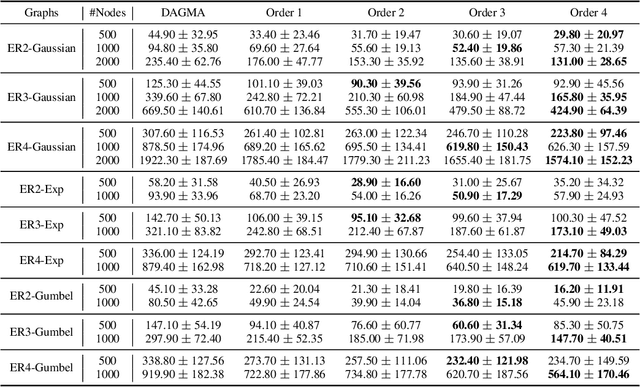
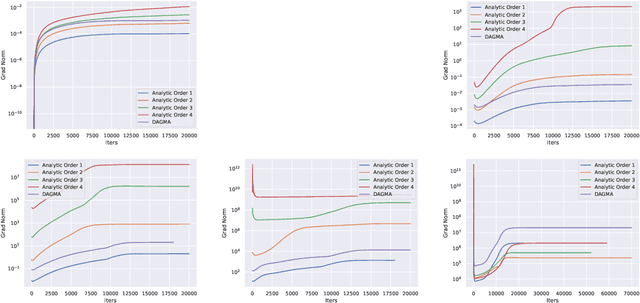
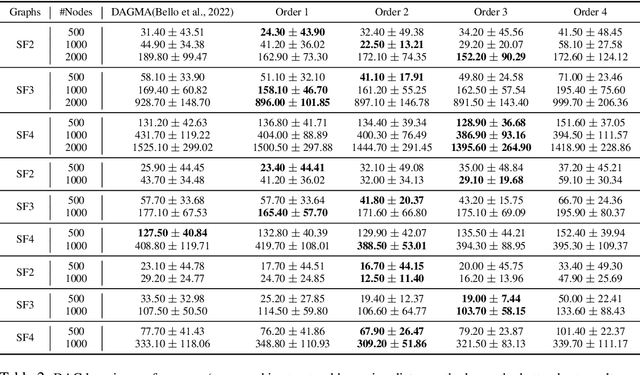

Recovering the underlying Directed Acyclic Graph (DAG) structures from observational data presents a formidable challenge, partly due to the combinatorial nature of the DAG-constrained optimization problem. Recently, researchers have identified gradient vanishing as one of the primary obstacles in differentiable DAG learning and have proposed several DAG constraints to mitigate this issue. By developing the necessary theory to establish a connection between analytic functions and DAG constraints, we demonstrate that analytic functions from the set $\{f(x) = c_0 + \sum_{i=1}^{\infty}c_ix^i | \forall i > 0, c_i > 0; r = \lim_{i\rightarrow \infty}c_{i}/c_{i+1} > 0\}$ can be employed to formulate effective DAG constraints. Furthermore, we establish that this set of functions is closed under several functional operators, including differentiation, summation, and multiplication. Consequently, these operators can be leveraged to create novel DAG constraints based on existing ones. Using these properties, we design a series of DAG constraints and develop an efficient algorithm to evaluate them. Experiments in various settings demonstrate that our DAG constraints outperform previous state-of-the-art comparators. Our implementation is available at https://github.com/zzhang1987/AnalyticDAGLearning.
* Accepted to ICLR 2025
When Selection Meets Intervention: Additional Complexities in Causal Discovery
Mar 10, 2025We address the common yet often-overlooked selection bias in interventional studies, where subjects are selectively enrolled into experiments. For instance, participants in a drug trial are usually patients of the relevant disease; A/B tests on mobile applications target existing users only, and gene perturbation studies typically focus on specific cell types, such as cancer cells. Ignoring this bias leads to incorrect causal discovery results. Even when recognized, the existing paradigm for interventional causal discovery still fails to address it. This is because subtle differences in when and where interventions happen can lead to significantly different statistical patterns. We capture this dynamic by introducing a graphical model that explicitly accounts for both the observed world (where interventions are applied) and the counterfactual world (where selection occurs while interventions have not been applied). We characterize the Markov property of the model, and propose a provably sound algorithm to identify causal relations as well as selection mechanisms up to the equivalence class, from data with soft interventions and unknown targets. Through synthetic and real-world experiments, we demonstrate that our algorithm effectively identifies true causal relations despite the presence of selection bias.
* Appears at ICLR 2025 (oral)
Permutation-Based Rank Test in the Presence of Discretization and Application in Causal Discovery with Mixed Data
Jan 31, 2025


Recent advances have shown that statistical tests for the rank of cross-covariance matrices play an important role in causal discovery. These rank tests include partial correlation tests as special cases and provide further graphical information about latent variables. Existing rank tests typically assume that all the continuous variables can be perfectly measured, and yet, in practice many variables can only be measured after discretization. For example, in psychometric studies, the continuous level of certain personality dimensions of a person can only be measured after being discretized into order-preserving options such as disagree, neutral, and agree. Motivated by this, we propose Mixed data Permutation-based Rank Test (MPRT), which properly controls the statistical errors even when some or all variables are discretized. Theoretically, we establish the exchangeability and estimate the asymptotic null distribution by permutations; as a consequence, MPRT can effectively control the Type I error in the presence of discretization while previous methods cannot. Empirically, our method is validated by extensive experiments on synthetic data and real-world data to demonstrate its effectiveness as well as applicability in causal discovery.